
 Apple Podcasts
 YouTube
 Spotify
 Amazon Music
 Overcast
Your Job in Retirement? You are the CEO of Your Own Wellness
You spent 30 years crushing quarterly targets. Revenue goals. Project deadlines. Performance reviews. You hit your numbers.
And then you retired. Suddenly, all that strategic thinking, all that discipline, all that relentless focus... has no target. Until now.
This episode reframes wellness as your primary "job" in retirement—not as an obsession, but as a strategy.
Because here's the uncomfortable truth: you can have $5 million in the bank, but if you lose your health at 68, that money just funds medical bills instead of adventures. Your health determines the quality of every other retirement decision. Time to treat it that way.
What You'll Learn
Health as Enabler vs. Health as Obsession
The critical distinction between optimizing for maximum health span (obsession) and optimizing for maximum life quality (enabler). Why your goal isn't being the fittest 55-year-old at the gym—it's being fit enough to hike Machu Picchu at 68 and play on the floor with grandkids at 72.
The Four Departments of Your Health "Job"
A strategic framework for managing wellness like you managed your career: Preventive Care (early detection), Movement & Fitness (maintaining capability), Nutrition (fueling properly), and Mental Health (cognitive and emotional wellbeing).
Becoming Your Own Healthcare CEO
How to actively manage your healthcare like a business: owning your medical records, interviewing doctors, understanding medications, and coordinating your healthcare team. You're not a passive recipient—you're the CEO.
The Quarterly Health Review System
A structured approach to tracking and improving your health metrics: reviewing data, celebrating wins, identifying challenges, making adjustments, and setting one measurable goal per quarter. Exactly what you did in your corporate career—except now you're the company.
Evidence-Based Minimums for Fitness and Nutrition
The specific, research-backed prescriptions from Mayo Clinic and Harvard: 150 minutes cardio, 2-3 strength sessions, balance training, and the 80/20 nutrition rule that gives room for pizza Friday.
Join the Conversation
Website: www.casualmondayspodcast.com
Instagram: @casualmondayspodcast
YouTube: Casual Mondays Podcast
Casual Mondays Club: https://www.casualmondayspodcast.com/newsletter/
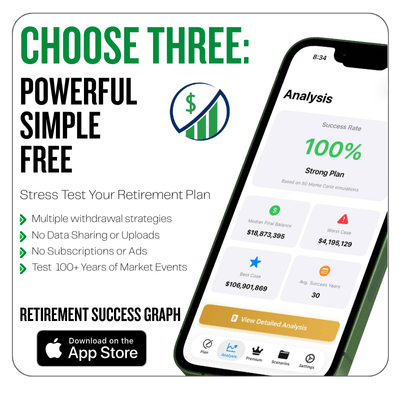
Stress-Test Your Retirement Plan with the Retirement Success Graph App
Powerful. Secure. Free.
Stress test your retirement plan against 100+ years of market data with the Retirement Success Graph app. See hundreds of possible futures for your portfolio. Test different scenarios—what if you spend more? Travel more? Live to 100?
Essential Resources
Health Tracking Tools:
- MyFitnessPal - Nutrition and calorie tracking (myfitnesspal.com)
- Cronometer - Detailed micronutrient tracking (cronometer.com)
- Apple Health / Google Fit - Activity and sleep tracking
- Strong app - Strength training tracking (iOS/Android)
- Strava - Running, cycling, hiking tracking (strava.com)
Finding Healthcare Providers:
- Zocdoc - Find and book doctors (zocdoc.com)
- Psychology Today - Find therapists (psychologytoday.com/us/therapists)
- Vitals - Doctor reviews and ratings (vitals.com)
Fitness Resources:
- SilverSneakers - Fitness program for Medicare beneficiaries
- National Institute on Aging Exercise Guide (nia.nih.gov/health/exercise-physical-activity)
- YouTube: "Fitness Blender" (home workouts), "Yoga With Adriene" (accessible yoga), "HASfit" (senior fitness)
Nutrition Resources:
- USDA MyPlate for Older Adults (myplate.gov/life-stages/older-adults)
- Harvard Healthy Eating Plate (hsph.harvard.edu/nutritionsource/healthy-eating-plate)
Mental Health Resources:
- SAMHSA National Helpline - Free, confidential, 24/7: 1-800-662-4357
- BetterHelp / Talkspace - Online therapy platforms
- 7 Cups - Free emotional support and counseling (7cups.com)
Books Recommended:
- Younger Next Year by Chris Crowley & Henry S. Lodge, MD
- Outlive: The Science and Art of Longevity by Peter Attia, MD
- The Blue Zones by Dan Buettner
- Why We Sleep by Matthew Walker, PhD
Research & Academic Resources
Preventive Care:
- Centers for Disease Control - Prevention Guidelines for Adults 50+
Preventive care highest-ROI healthcare investment; early detection improves outcomes
cdc.gov/aging/
Exercise and Aging:
- Mayo Clinic - Healthy Aging Research
150 min/week moderate cardio OR 75 min/week vigorous; 2-3 strength sessions non-negotiable
mayoclinic.org/healthy-lifestyle/healthy-aging - Harvard Medical School - Exercise and Cognitive Health
Cardiovascular exercise protects cognitive function; strength training slows muscle mass decline
health.harvard.edu
Nutrition:
- National Institute on Aging - Nutrition Guidelines
Protein needs increase after age 50 (1-1.2g per kg body weight)
nia.nih.gov - Harvard School of Public Health - Nutrition Research
Healthy fats support brain health; added sugar drives inflammation
hsph.harvard.edu/nutritionsource
Mental Health:
- National Institute of Mental Health - Retirement and Mental Health
Retirement commonly triggers depression, anxiety, and identity crisis
nimh.nih.gov - University of California San Francisco - Cognitive Health and Aging
Lifelong learning, social engagement, exercise protect cognition
ucsf.edu
Medication Management:
- American Geriatrics Society - Polypharmacy Research
Polypharmacy major risk factor for adverse drug events; annual medication review essential
americangeriatrics.org
Patient Engagement:
- Mayo Clinic - Patient Engagement Research
Informed, active patients have better outcomes than passive patients
mayoclinic.org
Cardiovascular Health:
- American Heart Association - Retirement Welln...
Trade your corporate shoes for sandals and your desk for a deck chair. This is the Casual Mondays Podcast with Kevin Donahue, sharing conversations about the highs, lows, and all of the in betweens, and helping retirees enjoy their brightest days.
Kevin Donahue:You spent thirty years crushing quarterly targets, revenue goals, project deadlines, performance reviews. You hit your numbers, delivered results, made things happen. You were strategic, disciplined, relentless. And then you retired. Suddenly, all that strategic thinking, all that discipline, all that relentless focus has no target.
Kevin Donahue:Until now. Because here's what I want you to consider: What if you treated your health with the same strategic focus you once gave quarterly earnings? What if preventive wellness became your new performance metric? What if you approached your body the way you approached your business as an asset that requires strategic investment, regular maintenance, and long term planning? You're planning for forty years of retirement, maybe fifty.
Kevin Donahue:But here's the uncomfortable truth. None of that matters if you lose your health at 68. The travel plans? Canceled because you can't walk more than 50 yards. The grandkids?
Kevin Donahue:You were too tired to keep up with them. The hobbies you wanted to pursue? Your body won't cooperate. All that money you saved? Going to medical bills instead of experiences.
Kevin Donahue:Your health determines the quality of every other retirement decision. Which means health isn't just important, it's the foundation. I'm Kevin Donahue. This is Casual Mondays, and today we're reframing wellness as a new strategic focus and making it your primary job in retirement. Before we go any further, I need to say something here as a guy who needs to drop some pounds and to make distinction to frame this conversation a bit.
Kevin Donahue:There are two ways to approach health in retirement. One approach is treating your health as an obsession. This is the person who tracks every calorie, every macro, every supplement. Works out two hours a day, six days a week. Reads every health study, tries every biohack.
Kevin Donahue:Makes health their entire identity. Judges others for unhealthy choices, lives in fear of aging, decline, death. This person is optimizing for maximum health span at the expense of actually living. And on the other side, I think, is the person approaching health as an enabler. This is the person who maintains fitness sufficient to do the things they love, eats well enough to feel good with room for pizza Friday.
Kevin Donahue:Has preventive systems in place without obsessing. Views health as the foundation that enables other goals. Accepts that aging happens and focuses on maintaining function. This person is optimizing for maximum life quality with health as the enabling foundation. I'm advocating for approach two.
Kevin Donahue:Your goal isn't to be the fittest 55 year old at the gym. Your goal is to be fit enough to hike Machu Picchu at 68, to play on the floor with your grandkids at 72, to travel independently at 80. Health is the asset that enables everything else you want to do in retirement. So let's treat it strategically. And here's the reframe.
Kevin Donahue:For thirty years, you had a job that provided structure, purpose, and measurable outcomes. Your job is keeping your body and mind functioning at a level that allows you to live the retirement you planned for. That job has four departments: Preventive Care, catching problems early Movement and Fitness, maintaining physical capability Fueling the machine properly
Announcer:Protecting cognitive and emotional well-being. Let's break down each one.
Kevin Donahue:First, preventive care. This is our early detection system. This is changing the oil in the car. Think about this like quarterly business reviews. You don't wait until the company has failed to look at the numbers.
Kevin Donahue:You check metrics regularly to catch problems early. Your body works the same way. According to the United States Centers for Disease Control, preventive care is the single highest ROI healthcare investment you can make. Early detection of cancer, cardiovascular disease, diabetes, and other conditions dramatically improves outcomes and reduces costs. And this is all of those things that you know but have overlooked a few times, or more than a few times, that every year you are getting a physical exam with your primary care physician.
Kevin Donahue:You're having your blood work drawn annually to check your comprehensive metabolic panel, lipid panel, your A1C, your thyroid. Blood pressure monitoring, one that I have coming up next month. Skin cancer screening with the dermatologist, especially if you have sun exposure history out there on the lake, the golf course, the pickleball courts, and so on. Dental cleaning and exam, at minimum twice yearly is better, and an annual vision exam. They have vision centers in your Target and Walmart stores.
Kevin Donahue:That's how common these need to be. Let's pull back to every two to three years, have your hearing tested, especially after age 50.
Announcer:With all the headphones, Beastie Boys tapes, and Guns N' Roses concerts that Gen X went through, this is really important for early retirees as well. How awful would it be to work your career to get to spend time with the ones you love but you can't hear or understand them? Get it done.
Kevin Donahue:And then you have your age specific screenings. Colonoscopy starting at 45, then every ten years more frequently based on results. Men in particular tend to shy away from this one, but it is quickly becoming one. The most deadly forms of cancer and early screenings can make it almost a non starter for you. Mammogram.
Kevin Donahue:Annually starting at 40 for women. Not a lot of fun, I've heard, but you ladies are a tough lot. Prostate screening. Discuss with your doctor starting at 50 for men, especially if you start to see signs like getting up in the middle of the night to go to the bathroom every night. Bone density scans starting at 65 for women, 70 for men.
Kevin Donahue:Earlier if risk factors. If you're a smoker or former smoker, get a low dose CT for lung cancer. Now, that's a long list, right? It is. Because this is your job now.
Kevin Donahue:You used to spend forty hours a week at work. You can spend twenty hours per year on preventive healthcare. And here's the key: track it. Most large practice medical groups are putting this on an app that makes it easy to schedule appointments on your phone. Create a spreadsheet.
Kevin Donahue:Set calendar reminders. Treat it like the performance dashboard it is. Last colonoscopy, 2022. Next due, 2032. Last blood work, January 2024.
Kevin Donahue:Next due, January 2025.
Announcer:Last dental cleaning, March 2024. Next due, September 2024.
Kevin Donahue:You tracked quarterly earnings. Track your health metrics the same way. Let's talk about your fitness. You're not training for the Olympics. You're training to maintain functional capability for forty years.
Kevin Donahue:And I don't care if you're an athlete or a couch potato. No one wants to end up unable to get themselves to and from bathroom. None of us want to rely on someone else for our independence. So let's train for the next few decades. Mayo Clinic give a surprisingly specific outline for maintaining your physical fitness.
Kevin Donahue:As a minimum, they say you should be getting one hundred and fifty minutes per week of moderate activity or seventy five minutes per week of vigorous activity, that means brisk walking, cycling, swimming, or something you enjoy or can at least tolerate. Something a little quicker than walking the dog. Strength training, two to three sessions per week, all major muscle groups.
Announcer:This is non negotiable. Muscle mass declines three to 5% per decade after age 30. Strength training is the only way to slow this.
Kevin Donahue:You don't need a gym. Body weight exercises, resistance bands, or dumbbells work fine. Balance training, two to three sessions per week, especially after age 60. I was a little surprised to learn that falls are the leading cause of injury related death in people 65. Simple exercises, standing on one foot or heel to toe walking, can make a substantial difference.
Kevin Donahue:Flexibility, daily stretching or yoga, maintains range of motion, reduces injury risk, improves quality of life. Here's what this looks like in practice. Monday, thirty minute walk plus fifteen minute stretching. Tuesday, strength training, legs, core, back, forty five minutes. Wednesday, rest or gentle yoga.
Kevin Donahue:Thursday, thirty minute bike ride plus fifteen minute stretching. Friday, strength training, upper body core, forty five minutes. Saturday, sixty minute hike or longer walk. Sunday, rest or gentle movement. That's it.
Kevin Donahue:Not obsessive, strategic. Okay. Nutrition. Again, this is coming from research, not just platitudes from the fat guy. I'm not gonna give you a diet.
Kevin Donahue:We don't need another diet. We need principles. A study from Harvard Public Health says the nutrition framework for healthy aging is, one, eat mostly whole foods. Vegetables, fruits, whole grains, lean proteins, nuts, seeds. Foods that existed one hundred years ago.
Kevin Donahue:Not never eat processed food, but make 80% of your diet real food. Principle two: Prioritize Protein. After age 50, protein needs actually increase. You need one to 1.2 grams per kilogram of body weight daily to maintain muscle mass. For a one hundred and eighty pound person, that's 80 to 100 grams of protein per day.
Announcer:Most retirees under consume protein. Fix this.
Kevin Donahue:Number three, don't fear healthy fats. Olive oil, avocados, nuts, fatty fish. These support brain health, hormone production, and nutrient absorption. Limit added sugar and ultra processed foods. This is where most people get in trouble.
Kevin Donahue:Sugar drives inflammation, insulin resistance, and accelerated aging. Not zero sugar, just conscious about it. Number five, stay hydrated. Thirst sensation decreases with age. Drink water intentionally.
Kevin Donahue:Aim for half your body weight in ounces daily. And here's the eightytwenty rule. Eat strategically 80% of the time. Eat socially and joyfully 20% of the time. Pizza Friday with friends?
Kevin Donahue:Great. Do it. Wine with dinner? Fine. Birthday cake?
Kevin Donahue:Enjoy it. Health is enabler, not obsession. And that's it. You're not a college kid. Don't eat like one.
Kevin Donahue:Department four is for our mental health. Staying sharp and balancing emotions. I would be willing to bet this is the one that 75% of us are neglecting. Maybe more than 75% because we grew up in an era where you just rubbed some dirt on it and got back out there. And, honestly, that was a mistake.
Kevin Donahue:We think nothing of spending $200 per month on a gym membership, but resist spending $150 on a therapy session. Retirement is a significant life transition that commonly triggers depression, anxiety, and identity crisis. You're not weak for struggling, you're human. Let's start getting it right. As a baseline, start establishing a relationship with a therapist now.
Kevin Donahue:You don't need to be in crisis to see a therapist. Think of it like having a primary care doctor. You have one before you're sick. Find a therapist who specializes in life transitions or geriatric psychology. Schedule quarterly check ins even if things are fine.
Kevin Donahue:For brain and cognitive health, it's not too hard to stay sharp. UC San Francisco says the activities that best protect cognitive function are Lifelong learning, such as taking classes, learning instruments, studying languages. Social engagement, which we covered in our last episode. Physical exercise. I feel like we just talked about this.
Kevin Donahue:What was it? Four minutes ago. Quality sleep, seven to nine hours nightly. Managing cardiovascular risk factors, blood pressure, cholesterol, diabetes with annual doctor's appointments or specialist care. It's like all of this is connected or something.
Kevin Donahue:Notice there's no magic supplement. There's no brain game app. It's the basics, done consistently. Your stress management toolkit should include at least two of: Meditation or mindfulness practice Regular physical activity Time in nature Creative pursuits Social connection Professional therapy And one critical note, if you're experiencing persistent sadness, loss of interest in activities, changes in sleep or appetite, or thoughts of self harm, That's not just retirement adjustment, that's clinical depression. I want you to hear me because I see you.
Kevin Donahue:I have scared myself before with depression and, thank God, spoke to my doctor about it. I beg you to see a professional. There's no shame in this. There's only shame in suffering unnecessarily when help exists. And if you or someone in your sphere is ever in need of urgent help, please call or text 988.
Kevin Donahue:Just like 911, they have experts ready to help. More on your health strategy in just a moment. But first, thank you for streaming Casual Mondays. If this episode is helpful, please leave a five star rating in your podcast app. You'll find all of the resources and links from today's episode in sound notes of your podcast app and online, ready to share with someone you think might like the show online at casualmondayspodcast.com.
Kevin Donahue:And if you want to stress test your retirement finances so you can focus on the health we're discussing today, download the Retirement Success Graph app. Free on iOS with premium features available for a one time $5 purchase. No subscriptions. Get it at retirementsuccessapp.com. Now let's talk about becoming your own healthcare CEO.
Kevin Donahue:Here's something they don't teach you before retirement. You need to become the CEO of your own health care. For your entire career, you probably had good employer sponsored health insurance. You saw your doctor, followed their recommendations, and the system mostly worked. In retirement, especially early retirement before Medicare, the system gets more complicated, and you need to actively
Announcer:manage Cash Mondays Podcast is supported by the Retirement Success Graph App, available as a free download on the Apple App Store. Want to see if your retirement plan can handle the next thirty to forty years? Create Retirement Success Master's Curve Graph uses advanced Monte Carlo modeling to stress test your plan to show you hundreds of possible futures
Kevin Donahue:Test for your different
Announcer:scenarios. If you spend
Kevin Donahue:more? Travels or
Announcer:lift to 100? Family doctors a quick tap away
Kevin Donahue:and vaccinations.
Announcer:Deeper analysis, upgrade to the premium version, which includes more detailed social security modeling and for five different drawdown strategies. Download the free app on the Apple
Kevin Donahue:App Store or online retirement success app and evaluate your about your financial future. You're not stuck with a doctor just because they're in network. If your doctor rushes through appointments without listening, dismisses your concerns, doesn't explain things clearly, seems more interested in prescribing than preventing. Find a new doctor. You're the customer.
Kevin Donahue:Act like it. The CEO of your healthcare must understand your medications. Every time a doctor prescribes something, ask, What is this for? What are the side effects? How long will I need to take this?
Kevin Donahue:Are there alternatives? What happens if I don't take this? And annually, do a medication review with your primary care doctor. Bring every pill bottle. Ask, Do I still need all of these?
Kevin Donahue:Many people are on medications they no longer need simply because the automatic refills never stopped. As the CEO of your healthcare, it is critical that you research and ask questions of your physicians. Let me be clear, I'm not talking about finding alternative medicine or taking certain supplements or animal grade medications because you saw it on YouTube. Uh-huh. What I do mean is when a doctor recommends a test, procedure, or treatment, you're allowed to ask, Why do I need this?
Kevin Donahue:What are the risks? What happens if I don't do this? Are there alternatives? What does the evidence say? This isn't being difficult, this is being informed.
Kevin Donahue:And lastly, as the CEO, you build a healthcare team, not just a doctor. Your healthcare team might include primary care physician, your quarterback, dentist, eye doctor, specialists as needed, cardiologist, dermatologist, etc, physical therapist for injury prevention and rehabilitation, Mental health therapists. Pharmacists. Underutilized resource. They know drug interactions better than most doctors.
Kevin Donahue:You're coordinating all of them. And here's the mindset shift. You're not a passive recipient of healthcare. You're managing a complex system to maintain your most valuable asset, your health. That requires active engagement, continuous education, and strategic decision making.
Kevin Donahue:Sound familiar? Because that's exactly what you did in your career. Now apply those skills here. Okay, we're rolling into the finish with quarterly health reviews. Four times per year, January, April, July, October, sit down and review your health metrics.
Kevin Donahue:Pull out your tracking spreadsheet. Look at: Any overdue appointments? Schedule them now. How many weeks did you hit? One hundred and fifty minutes of cardio.
Kevin Donahue:How many strength training sessions? Are you getting enough protein? Rate your mood: one to 10. Rate your stress: one to 10. Rate your life satisfaction: one to 10.
Kevin Donahue:Any concerning trends? How many hours of sleep are you getting a night? Make a list of this quarter's wins and challenges. What went well this quarter? I stuck to my walking routine and finally scheduled that colonoscopy.
Kevin Donahue:Celebrate this. Acknowledge progress. What was challenging? My stress was high in March, and I haven't spoken to a professional about it. No judgment.
Kevin Donahue:Just data. Based on your metrics and observations, employ the Start Stop Keep method that we've talked about so many times on this show. Choose one new thing to start. Add balance exercises twice weekly. Start food journaling to track protein intake.
Kevin Donahue:One thing to stop. Stop skipping. Stretching after workouts. Probably why I hurt my shoulder. Stop having wine four nights per week.
Kevin Donahue:Cut back to two. One thing to keep. Morning walks are working great, keep going. Mental health check ins with therapists, maintain quarterly schedule. And lastly, as we talked about in our previous episodes as well, set one goal, Not five, but a one new quarterly goal for your health.
Kevin Donahue:Complete 25 strength training sessions, about two per week. Lose five pounds, about one to 1.5 per month. Meditate 50 times, about four per week. Make it specific, measurable, achievable. And here's why the quarterly health review works.
Kevin Donahue:It's long enough to see patterns but short enough to adjust before things get out of control. It's structured, which your brain loves. It's data driven, which removes emotion and judgment, and it's exactly what you did in your corporate career, except now you're the CEO and the company is your lifetime health. Before we wrap up, I want to share one more resource. If you're looking for a simple way to track your retirement health metrics alongside your financial plan, the Retirement Success Graph app can help.
Kevin Donahue:While its primary function is stress testing your portfolio with Monte Carlo simulation, The premium version includes a health expectancy calculator that shows how lifestyle factors impact your retirement timeline. It's a sobering reminder that financial planning and health planning are inseparable. Download it free on iOS at retirementsuccessapp.com. Premium features are just a one time five dollars purchase. Now let's review our action steps.
Kevin Donahue:Your health determines the quality of every other retirement decision, which means it's not optional. It's foundational. You spent thirty years being strategic in your career. Now apply that same discipline to your body. Your assignment: Step one: Create your Preventive Care Dashboard.
Announcer:Open a spreadsheet or a journal. List every screening and test you should be getting. Record when you last did it. Calculate when it's next due. Set calendar reminders.
Kevin Donahue:Step two: Design your movement plan. What's your realistic, sustainable weekly routine? Cardio one hundred and fifty minutes minimum. Two to three sessions. Two to three sessions, if over 60.
Kevin Donahue:Daily.
Announcer:Write it down. Put it on your calendar.
Kevin Donahue:Step three: Build your healthcare team. Who's on your roster? It's like the NFL draft. Name your primary care physician, your dentist eye doctor, and Emmental health coach. If you don't have a mental health therapist, find one.
Kevin Donahue:Even if you don't think you need it. This is preventive care for your mind. Step four, schedule your first quarterly health review. January, April, July, or October. Put sixty minutes on your calendar to review, metrics, wins and challenges, adjustments, one goal for next quarter.
Kevin Donahue:Treat it like a board meeting because you're the CEO. And remember, health as enabler, not obsession. You're not optimizing for maximum health span. You're optimizing for maximum life quality with health as the enabling foundation. The goal isn't to live to 100 as a fitness model.
Kevin Donahue:The goal is to live to 85 doing the things you love: hiking, playing with grandkids, traveling independently. And that requires strategy. You already know how to be strategic. You've been doing it for thirty years. Now apply it here.
Kevin Donahue:On our next episode, we're talking about the bucket list myth, skydiving, safari in Africa. But whose bucket list is it really? We'll explore how to create meaningful experiences aligned with your values rather than Instagram expectations of retirement adventures. Until then, build your preventive care dashboard, design your movement plan, and remember that your health is the foundation for everything else. I'm Kevin Donahue.
Kevin Donahue:This has been the Casual Mondays Podcast. Thank you ever so much for listening. Cheers to you and your good health.
Announcer:Thank you for streaming today's episode. For more from our conversation, you'll find links and resources in the show notes. If you would like to join the show, record your story as a voice message on our website at casualmondayspodcast.com. You'll also find our Casual Mondays Club newsletter on the website with behind the scenes notes, suggestions, and previews delivered to your email inbox every month. As always, be sure to click subscribe in your app so our future episodes are available automatically.
Announcer:And help us connect to friends and colleagues by giving a star rating on your podcast app and sharing on your social network. This has been the Casual Mondays Podcast. Until next time, keep it casual.