Your Reason for Being Beyond the Paycheck: Discovering Ikigai in Retirement
You've filled your calendar. Golf on Tuesdays, volunteering on Wednesdays, lunch with old colleagues on Thursdays. You're busier now than when you were working, yet something fundamental feels missing. You're checking boxes but not finding meaning. You're in motion but not moving forward.
This is the paradox that catches so many early retirees off guard: activity without purpose is just exhaustion with better scenery.
The Difference Between Being Busy and Having Purpose
In your career, purpose was externally defined. Quarterly targets, project deadlines, performance reviews—the corporate machine provided structure, meaning, and identity. Strip that away, and many discover they've been deriving their sense of purpose from sources outside themselves for decades.
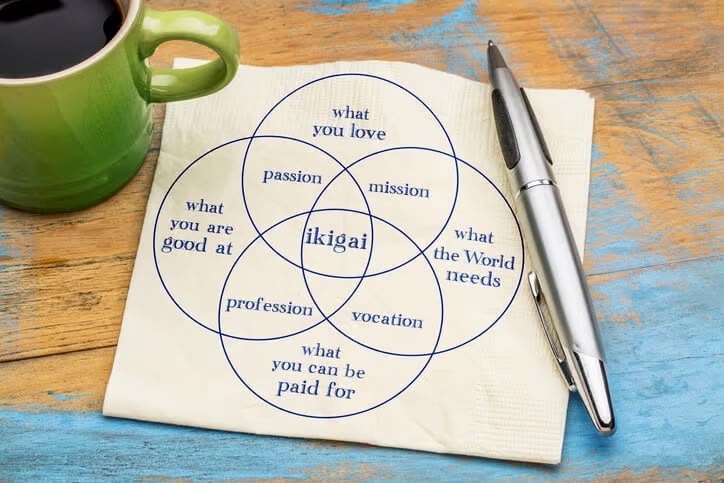
The Japanese concept of ikigai (生き甲斐) translates roughly to "a reason for being" or "that which makes life worth living." Unlike Western notions of purpose that often center on career achievement or financial success, ikigai is something more fundamental—the intersection of what you love, what you're good at, what the world needs, and what provides sustainable fulfillment.
Research from Japan's Okinawa Centenarian Study has tracked residents of Okinawa for decades, studying why this region produces more centenarians per capita than anywhere else on Earth. Among the key factors? A strong sense of ikigai. Okinawans who articulated a clear reason for waking up each morning lived longer, healthier lives than those who didn't, even when controlling for diet, exercise, and genetics.
Why Traditional Goal-Setting Fails in Retirement
The corporate world taught us to set SMART goals: Specific, Measurable, Achievable, Relevant, Time-bound. These frameworks excel at driving quarterly results. They fail spectacularly at creating meaning in retirement.
Why? Because retirement isn't a project with a defined endpoint. There's no promotion waiting at the finish line, no bonus for exceeding expectations. The metrics that mattered for 30 years—revenue growth, market share, employee headcount—become irrelevant. You need a different compass entirely.
Stanford Center on Longevity research shows that retirees who focus solely on activity-based goals ("play golf twice a week") without deeper purpose report lower life satisfaction than those who connect activities to broader meaning ("maintain physical health to travel with grandchildren"). The activity is the same; the framing is everything.
The Four-Circle Ikigai Framework Adapted for Retirement
The traditional ikigai model uses four overlapping circles. For retirees, we need to reframe these questions away from career-centric thinking:
1. What Do You Love?
Not what society says you should enjoy in retirement, but what genuinely energizes you. Many retirees discover that activities they tolerated in their career years (networking events, public speaking, mentoring) become sources of deep satisfaction when pursued on their own terms. Others find that hobbies they relegated to weekends become central to their identity.
2. What Are You Good At?
Your professional skills don't expire the day you retire. Strategic thinking, relationship building, problem-solving, project management—these capabilities can be redirected toward new domains. The Harvard Study of Adult Development, which has tracked participants for over 80 years, found that individuals who successfully repurpose professional competencies into new contexts report higher well-being than those who abandon their skill sets entirely.
3. What Does the World Need?
This is where retirees often stumble. You spent decades meeting market needs. Now the question becomes: what needs speak to you personally? This might be mentoring young entrepreneurs, supporting environmental causes, strengthening your local community, or providing caregiver support. The "world" here isn't abstract—it's the specific corner of the world where you can make a tangible difference.
4. What Can Sustain You?
This isn't just about money (though financial sustainability matters). It's about energy, time, and emotional bandwidth. Can you pursue this for years without burning out? Will it remain fulfilling even when it's challenging? Does it align with your values and the lifestyle you want to maintain?
Measuring Your Retirement Plan Against Reality
Purpose is one pillar of retirement success. Financial security is another. While ikigai addresses the "why" of retirement, you also need confidence in the "how"—specifically, how your financial plan will perform across decades of unknown market conditions.
This is where Retirement Success Graph becomes essential. Unlike traditional retirement calculators that assume straight-line growth, this iOS app uses the same Monte Carlo modeling that institutional investors and financial advisors rely on. It stress-tests your retirement plan against over 100 years of actual market data—including crashes, recessions, and inflation spikes.
The free version runs 50 simultaneous simulations to show the probability your money will last through age 95. Want deeper analysis? A one-time $4.99 purchase unlocks premium features: 10,000 simultaneous simulations, multiple withdrawal strategies, Social Security optimization scenarios, and modeling for windfalls or one-time expenses.
Best part? Your data never leaves your device. No subscriptions, no ads, no privacy compromises—just professional-grade analysis on your terms. Download Retirement Success Graph from the App Store and validate your financial plan in minutes, not months.
Three Ikigai Archetypes in Retirement
Through years of observing successful retirees, three dominant ikigai patterns emerge:
The Mentor
These individuals find purpose in passing wisdom to the next generation—whether through formal programs, family involvement, or community teaching. Former executives often rediscover fulfillment mentoring startups. Teachers volunteer at literacy programs. Engineers help high school robotics teams. The MIT AgeLab research on intergenerational connection shows that mentoring relationships benefit both parties, improving cognitive function in mentors while providing invaluable guidance to mentees.
The Creator
Retirement finally provides uninterrupted time for creative pursuits. Writing, painting, woodworking, music, gardening—activities once squeezed into weekends become central. The National Endowment for the Arts research on creativity and aging demonstrates that sustained creative practice improves mental health, cognitive resilience, and overall life satisfaction in older adults.
The Connector
Some people are energized by bringing others together. They organize neighborhood gatherings, facilitate interest groups, coordinate volunteer projects, or strengthen family bonds. Research from the University of Michigan's Health and Retirement Study consistently shows that individuals with strong social roles report better physical and mental health outcomes than socially isolated peers.
Most retirees aren't purely one archetype—you might mentor while also pursuing creative projects. The key is recognizing which patterns resonate most deeply with you.
The Three-Month Ikigai Experiment
Finding your ikigai isn't a weekend workshop exercise. It's an iterative process requiring experimentation, reflection, and adjustment. Here's a practical framework:
Month 1: Exploration Phase
Commit to trying three new activities or revisiting three former interests. No pressure to excel—just exposure. Volunteer at a literacy program. Take a pottery class. Join a hiking group. Attend a speaker series. The goal isn't to find "the answer" but to generate data about what energizes versus drains you.
Month 2: Reflection Phase
After each activity, ask: Did time pass quickly or slowly? Did I feel energized or exhausted afterward? Did I look forward to the next session? Would I do this even without recognition or reward? Keep a simple journal—research from the American Psychological Association shows that structured reflection accelerates self-discovery.
Month 3: Commitment Phase
Based on your month-two insights, commit to one pursuit with greater intensity. Volunteer weekly instead of monthly. Take an advanced class. Lead a project. Intensity reveals whether an interest can sustain deeper engagement or if it works better as an occasional activity.
The Morning Question Ritual
One of the most powerful ikigai practices is deceptively simple: each morning, before checking your phone, ask yourself one question:
"What am I looking forward to today?"
If your answer is immediate and genuine, you're aligned with your ikigai. If you struggle to answer, that's valuable information too—it's a signal to reassess how you're spending your time.
Okinawan centenarians don't overthink ikigai—they live it daily through small choices. Tending their garden because they love nurturing growth. Gathering with neighbors because connection matters. Teaching grandchildren traditional crafts because passing knowledge forward gives life meaning.
Your ikigai won't arrive fully formed in a moment of clarity. It emerges through experimentation, reflection, and the courage to pursue what genuinely matters to you—not what retirement brochures suggest you should be doing.
Beyond the Bucket List
Ikigai stands in stark contrast to the traditional retirement bucket list—that collection of destination checkboxes and one-time experiences. A bucket list asks "What do I want to do before I die?" Ikigai asks "What makes life worth living day to day?"
Both have their place, but ikigai provides the sustainable foundation that bucket lists can't. Climbing Machu Picchu is a profound experience that lasts a week. Finding your reason for being is a profound experience that lasts decades.
The busiest retirees are often the least fulfilled because they've substituted one form of external validation (career success) for another (impressive activities). The most fulfilled retirees are those who've discovered what genuinely matters to them and built their days around it—even if that looks unimpressive to outside observers.
Your ikigai might be tending a community garden. Mentoring a single young entrepreneur. Writing poetry no one else will read. Teaching your grandchildren to fish. There's no hierarchy of importance, no better or worse answer. There's only your answer.
The Path Forward
Finding your ikigai in retirement isn't about adding more activities to an already crowded calendar. It's about creating space for what truly matters, then protecting that space fiercely.
It requires:
- Experimentation without the pressure of immediate answers
- Reflection to distinguish between what you should enjoy and what you actually enjoy
- Courage to pursue paths that may not make sense to others
- Patience to let meaning emerge rather than forcing it
The Japanese don't say "find your ikigai" as if it's a hidden treasure waiting to be unearthed. They say "cultivate your ikigai"—because it grows through attention, care, and daily practice.
You've spent decades building financial security. Now it's time to build purpose security—and that starts with understanding what truly makes life worth living for you.
Ready to dive deeper into these concepts? Listen to Episode 2 of Casual Mondays: "Finding Your Ikigai - Your Reason for Being Beyond the Paycheck" wherever you get your podcasts.
Concerned about whether your retirement plan can support your ikigai pursuits? Download Retirement Success Graph from the App Store to stress-test your financial strategy against decades of real market conditions—no subscriptions, no data sharing, just professional-grade analysis on your iPhone.

Author. Podcast Host. Pilgrim Backpacker. Aspiring Racer.
With a 25+ year track record of driving revenue, creating and repositioning brands, and developing leaders, Kevin Donahue is regarded as one of the elite marketing strategists and sales leaders in the luxury hospitality industry. He left the industry in his early fifties to prioritize intentional time as a husband and father, a pilgrim backpacker, an author, a digital developer, and a podcast host.
In his "retirement era", Kevin serves on the College of Business Advisory Council at Florida Gulf Coast University and is pursuing new passions, including auto racing and mobile app development.
For more on Kevin's active projects, please visit KevinDonahue.com and ChezMerStudios.com

The Cocktail Party Question That's About to Break Everyone